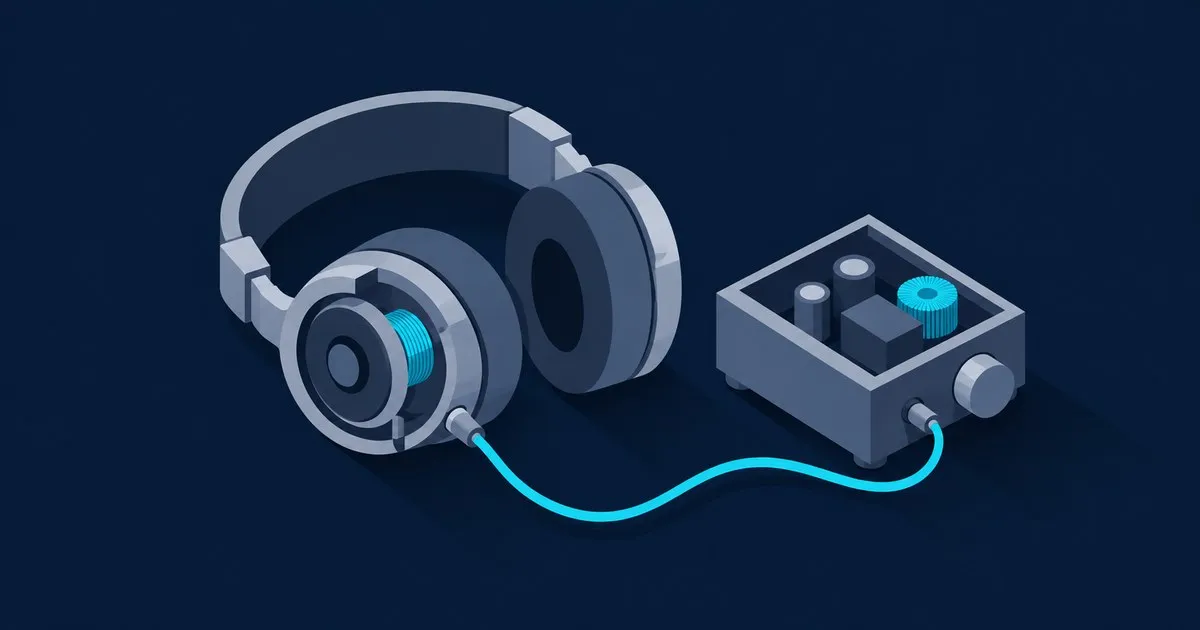
Headphone impedance is the electrical load a headphone presents, measured in ohms, and it sets how much voltage versus current your source must deliver, not how good the headphone sounds. With headphone impedance explained ohms-first: sensitivity decides loudness, 250 to 600 ohm models need voltage swing, and your amp’s output impedance should stay below one-eighth of the headphone’s rating.
What does the ohm rating on headphones actually mean?
The ohm rating is a nominal impedance: a single number, usually measured at 1 kHz, standing in for a value that changes with frequency. A “300 ohm” headphone is roughly 300 ohms through the midrange and can be much higher elsewhere, most often at the bass resonance of a dynamic driver.
Impedance is the AC equivalent of resistance. It combines the resistance of the voice coil wire with reactive effects from the coil’s inductance and the driver’s mechanical resonance, which is why it varies across the audio band. Sound On Sound’s survey of headphone impedance found 57 percent of the models it examined showed some variation with frequency, with moving-coil designs typically peaking around 100 Hz at values that can exceed 1.5 times the nominal rating.
Archimago’s measurements of a Sennheiser HD650 bear that out, showing about 300 ohms from 1 kHz to 6 kHz, rising to a 500 ohm peak at a 90 Hz resonance. His HD800 sample varied between 350 and 800 ohms. That curve is why amplifier output impedance matters.
Why doesn’t impedance alone tell you how loud headphones get?
Impedance alone cannot predict loudness because it says nothing about sensitivity: how efficiently the driver converts electrical input into sound. Two headphones with identical impedance can differ widely in output at the same voltage, and a low impedance model can still be hard to drive.
Sensitivity comes in two conventions, and mixing them up produces bad conclusions:
- dB/mW gives the sound pressure level for 1 milliwatt of input, describing efficiency in terms of power.
- dB/V gives the sound pressure level for 1 volt RMS of input, indicating how much voltage swing you need.
Converting between them requires the impedance. One volt into Z ohms delivers 1000/Z milliwatts, so:
dB/V = dB/mW + 10 × log10(1000 / Z)
For 32 ohms, add about 14.9 dB to the dB/mW figure. For 300 ohms, add about 5.2 dB. That gap is why a high impedance headphone with a respectable dB/mW figure can still feel quiet from a phone: each volt delivers far less power into 300 ohms than into 32.
Sound On Sound cites the Sennheiser HD650 at 105 dB/V and the Shure SE535 in-ear at 134 dB/V, so the HD650 needs roughly 28 times the voltage for the same level. Published figures also disagree: Thomann’s HD 650 listing quotes 103 dB, while Archimago measured close to 112 dB/V. When the unit is ambiguous, treat the number as approximate and leave headroom.
How much voltage and power do your headphones need?
Pick a target peak level, subtract the sensitivity in dB/V, and convert the difference to volts: V = 10^((target SPL − dB/V) / 20). Power follows from P = V² / Z. An amplifier must deliver that voltage and power into the load, plus some margin.
The table targets 110 dB SPL, a headroom figure for brief musical peaks, not a level anyone should sustain.
| Headphone (sensitivity source) | Impedance | Sensitivity | Voltage for 110 dB | Power for 110 dB |
|---|---|---|---|---|
| HD 650, published figure read as dB/V | 300 Ω | 103 dB/V | 2.24 V | 16.7 mW |
| HD 650, Archimago’s measured figure | 300 Ω | 112 dB/V | 0.79 V | 2.1 mW |
| Shure SE535, Sound On Sound figure | low (IEM) | 134 dB/V | 0.063 V | a fraction of a mW |
| Hypothetical closed-back | 32 Ω | 100 dB/mW (114.9 dB/V) | 0.57 V | 10 mW |
| Hypothetical studio model | 300 Ω | 100 dB/mW (105.2 dB/V) | 1.74 V | 10 mW |
The last two rows both need the same 10 mW, but the 300 ohm version needs three times the voltage. A small source that clips around one volt drives the 32 ohm model comfortably and runs out of swing on the 300 ohm one, even if its milliwatt rating looked adequate. That is what “high impedance headphones need an amp” means: they need voltage.
The first two rows show why ambiguous specs matter: the HD 650 needs from under a volt to over two volts depending on which figure is right. Shop against the conservative reading. The guide to matching a DAC and amp to your headphones walks through these inputs step by step.
Are low impedance or high impedance headphones better?
Neither is better for sound quality. Impedance is a design choice that matches a headphone to the source it expects. Low impedance suits phones, laptops and portable players with limited voltage. High impedance suits mains-powered amplifiers and studio gear that can swing several volts. The driver’s tuning determines sound, not the ohm figure.
Sound On Sound traces the split to history. Higher impedance designs were aimed at studios and home hi-fi, where a dedicated, mains-powered amplifier could supply the voltage. As battery and USB-powered devices took over consumer listening, low impedance became the norm because it extracts usable power from a small voltage.
Each type has its own practical trade-off:
- Low impedance, high sensitivity (most in-ears): easy to drive, but they expose the source’s noise floor. Hiss inaudible on a 300 ohm headphone can be obvious here; see how to fix headphone amp hiss and hum.
- High impedance (many 250 to 600 ohm studio models): tolerant of source noise and output impedance, but they need voltage swing that phones and many laptops lack.
- Low impedance, low sensitivity (common among planar magnetics): they need real current, so a source with plenty of voltage can still struggle.
What is the 1/8 rule for amplifier output impedance?
The 1/8 rule says your source’s output impedance should be no more than one-eighth of the headphone’s nominal impedance: under 4 ohms for a 32 ohm headphone, under 2 ohms for 16 ohms. NwAvGuy’s explanation sets it there because a damping factor of 8 keeps frequency response variation near 1 dB.
The mechanism is a voltage divider. The amplifier’s output impedance sits in series with the headphone, so the share of voltage reaching the driver depends on their ratio. Because the headphone’s impedance changes with frequency, the response follows its impedance curve. The level at the headphone is 20 × log10(Z_headphone / (Z_headphone + Z_out)).
Two worked examples show why the rule is relative, not absolute:
- HD650 from a 120 ohm source. At the 300 ohm midrange the driver gets 300/420 of the voltage, about −2.9 dB. At the 500 ohm bass peak it gets 500/620, about −1.9 dB. The bass rises by roughly 1 dB relative to the mids. Audible to some listeners, not dramatic.
- A hypothetical in-ear whose impedance swings from 8 to 40 ohms, fed from 10 ohms. The level runs from about −7.0 dB to −1.9 dB, a 5 dB tilt across the band. From a 1 ohm source the same earphone varies by under 1 dB.
NwAvGuy reports real cases: a 43 ohm source produced a very audible 12 dB of variation with certain earphones, and even 10 ohms caused 6 dB. The article adds that high output impedance reduces electrical damping, which tends to loosen bass control. Wikipedia’s headphone amplifier entry puts numbers on it: a 32 ohm headphone on a sub-1 ohm amplifier gets a damping factor above 32, while the same headphone on a 120 ohm output drops to 0.26.
NwAvGuy’s shortcut is simpler: a source under 2 ohms behaves well with nearly any headphone, and apart from tube and other esoteric designs, most high-end headphone sources meet it. For tube amps, see tube vs solid state headphone amps. A balanced output can have a different output impedance from the single-ended jack on the same unit, so check both, as balanced vs single-ended headphone amps explains.
Where does the 120 ohm standard fit in?
You may still see 120 ohms cited as the “correct” headphone output impedance. It comes from IEC 61938, introduced in 1996, which recommended a 120 ohm source so one jack could drive a wide range of headphones at a tolerable level. Sound On Sound notes it also limited power into sensitive models and lowered audible noise on in-ears.
It is rarely used today. Wikipedia records that a 2008 Stereophile article found a 120 ohm source could cause a 5 dB frequency response error with certain headphones. As the HD650 example shows, high impedance headphones tolerate it far better than low impedance ones. Treat 120 ohms as a legacy of older gear, not a design target.
How to check your own headphone and amp pairing
Work from the headphone outward:
- Find the nominal impedance and sensitivity, confirm the sensitivity unit, and convert dB/mW to dB/V.
- Calculate the voltage for your target peak, using the conservative figure if published and measured numbers disagree.
- Check the amp’s rated output at your headphone’s impedance. Milliwatts at 32 ohms say little about volts into 300 ohms.
- Check output impedance against the 1/8 rule, or the under-2-ohm shortcut if you own several headphones.
- Listen for hiss on very sensitive headphones. Plenty of power with audible noise is a mismatch too.
If your output falls short, do you need a DAC and amp covers whether to add one, and combo DAC/amp vs separates covers the form factor. Impedance matching is an amplifier question; the converter stage explained in what a DAC does rarely decides whether a headphone gets loud enough.
FAQ
are higher ohm headphones better quality
No, higher ohm headphones are not inherently better. Impedance reflects how the voice coil is wound and what source the headphone was designed for. Many excellent models are 32 ohms and many mediocre ones are 300 ohms. Judge sound quality from frequency response measurements and listening, and use impedance only to choose a suitable amplifier.
can a phone drive 250 ohm headphones
A phone can sometimes drive 250 ohm headphones, but often not to satisfying levels. Phones are voltage-limited, and a 250 ohm load needs more voltage for the same power. Convert the headphone’s sensitivity to dB/V, calculate the voltage needed for your peak level, and compare it with your phone’s or dongle’s rated output.
do 32 ohm headphones need an amp
Most 32 ohm headphones do not need a dedicated amp, provided their sensitivity is reasonable. At 32 ohms, a fraction of a volt usually delivers enough power. Exceptions include low-sensitivity planar magnetic models that need more current, and sources with high output impedance or audible hiss that a better amp would remove.
what happens if amp output impedance is too high
When amp output impedance is too high, the headphone’s frequency response follows its impedance curve, usually boosting bass around the driver resonance and softening control. Low impedance headphones and multi-driver in-ears suffer most, sometimes by several decibels. Keeping output impedance under one-eighth of the headphone rating holds the deviation near 1 dB.
Related across the network
- Studio Monitors vs Hi-Fi Speakers: Key Differences — studiomonitorguide.com
- Studio Monitor Size for Your Room: 5, 7 or 8 Inch — studiomonitorguide.com


